
Analyze the funnel
Real behavior data pulled to find the steps where visitors are actually dropping off.

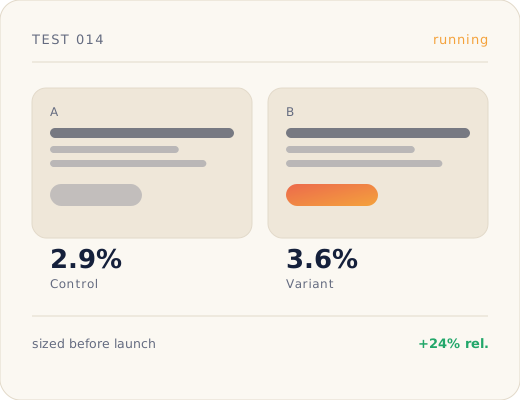
Most CRO is opinions about button colors. We run funnel analysis to find where visitors actually drop off, then test changes that are properly powered to reach significance.
The damage isn't one bad test. It's months of traffic spent on changes nobody ever confirmed actually worked.
A test stopped after four days of "looks like it's winning" is usually just noise, not a real result you can act on with confidence.
Without real funnel data, test ideas come from opinion and competitor screenshots instead of the step where people are genuinely leaving.
A change that helps new visitors but quietly hurts returning ones can read as a win overall while actually costing you your best customers.
A test program built on real drop-off data, sized to actually reach significance, and read at the segment level before we call anything a winner.


Every step of your funnel measured to find exactly where visitors actually drop off, instead of guessing from a heatmap screenshot.
Deliverable: Funnel analysis reportEvery field, step and distraction between cart and confirmation reviewed for the friction that's actually costing you completions.
Deliverable: Checkout friction auditSample size and runtime calculated before launch, so a test isn't called early on noise that looked like a trend.
Deliverable: Test plan & sample sizingNew vs. returning, mobile vs. desktop, checked separately so a win for one group hiding a loss for another doesn't get missed.
Deliverable: Segment-level readoutA running record of what was tested, what happened and why — so the next test builds on the last one instead of repeating it.
Deliverable: Test results logA confirmed winner gets rolled out properly, with the change documented so it doesn't get quietly reverted by the next redesign.
Deliverable: Winning changes shippedReal behavior data pulled to find the steps where visitors are actually dropping off.
Ranked by expected impact and ease of implementation, not by whoever argued loudest in the meeting.
Sized and timed to actually reach significance before any result gets called.
Confirmed winners rolled out, every result recorded so the program compounds over time.
We'd been calling tests after three or four days whenever the graph looked good. Learning our sample size needed two more weeks to mean anything changed how we run the whole program.
A checkout redesign we'd shipped six months earlier looked like a win in the top-line numbers. The segment-level read showed it had actually hurt mobile conversion the entire time.
Our checkout had eleven form fields and nobody had questioned why in years. The friction audit alone found four fields we didn't actually need, before a single test even launched.
We used to run three or four tests at once with no shared record of what had already been tried. The test log alone saved us from repeating a losing idea from eighteen months earlier.
We'd never actually looked at the funnel step by step before, just overall conversion rate. The drop-off was concentrated on one shipping page nobody had thought to check.
A "winning" homepage test from a previous agency had been live for a year with nobody checking it still worked. Re-testing it showed the lift had disappeared months ago.
Our prioritization used to just be whoever's idea got the most support in the Slack thread. Ranking tests by expected impact instead completely changed what we worked on first.
We assumed our test tool was splitting traffic evenly and never checked. One variant had been getting almost twice the traffic of the other for months, quietly skewing every result.
A shipped "winner" from the year before had never actually been verified against a real control group. Turned out it was a coincidence of timing, not the change itself, that had driven the original lift.
It depends on your current conversion rate and the size of the effect you're trying to detect. We calculate the actual number for your site before recommending a program.
Long enough to reach statistical significance at your traffic level, usually a minimum of two full weeks to account for day-of-week variation.
A losing test still tells us something real about your visitors, and it goes in the log so the next idea builds on it instead of repeating it.
Yes, from test setup through to shipping confirmed winners into your actual site, not just handing over a spreadsheet of recommendations.
Send us access and we will come back with a written audit: what is tracked, what is double-counted, what is missing, and what we would change first.
No pitch deck · No lock-in · Findings are yours either way